Monday, 9 April 2018

QTL ANALYSIS (GENETICS -UNIT 8 CSIR NET LIFE SCIENCES)

 LOCATION OF QUANTITATIVE GENES ON CHROMOSOME-QTL

Quantitative trait locus (QTL) analysis is a statistical method that links two types of information—phenotypic data (trait measurements) and genotypic data (usually molecular markers)—in an attempt to explain the genetic basis of variation in complex traits

 Molecular markers are preferred for genotyping, because these markers are unlikely to affect the trait of interest. Several types of markers are used, including single nucleotide polymorphisms (SNPs), simple sequence repeats(SSRs, or microsatellites), restriction fragment length polymorphisms (RFLPs), and transposable element positions.

 In  QTL analysis, the parental strains are crossed, resulting in heterozygous (F1) individuals, and these individuals are then crossed using either selfing/backcross/testcross.
The phenotypes and genotypes of the derived (F2) population are scored.

Markers that are genetically linked to a QTL influencing the trait of interest will segregate more frequently with trait values (large or small egg size in our example), whereas unlinked markers will not show significant association with phenotype.

 Small sample sizes may fail to detect QTL of small effect and result in an overestimation of effect size of those QTLthat are identified. This is known at the "Beavis effect.

QTL studies require very large sample sizes, and they can only map those differences that are captured between the initial parental strains.
Because these strains are unlikely to contain segregating alleles of large effect at every locus contributing to variation in natural populations, some loci will remain undetected.


Thank you for visiting my  blog.  Share your comments on this

article.  Subscribe and follow me in Google + to get notified with new articles.

Thursday, 15 February 2018

Types of endocytosis

Types of Endocytosis: Pinocytosis, Receptor-Mediated Endocytosis and Phagocytosis

Sunday, 7 January 2018

NEUTRAL THEORY OF MOLECULAR EVOLUTION PART B CSIR NET DEC 2017

The neutral theory of molecular evolution (proposed by MOTTO KIMURA) 1968 holds that at the molecular level most evolutionary changes and most of the variation within and between species is not caused by natural selection but by genetic drift of mutant alleles that are neutral.

SOME IMPORTANT POINTS -

  • Except for advantageous mutations most alleles are under neutral condition.
  • The rate of evolution for most genes will be equal to the neutral mutation rate .
  • At the level of Dna sequences,genetic drift dominates evolution i,e genetic drift is the main force changing allele frequency .
  • The rate of replacement in evolution resulting from the random genetic drift of effectively neutral mutations is equal to the mutation rate to such alleles, μ.
  •  Explained the unexpectedly high rate of evolutionary change and very large amount of intraspecific variability at the molecular level that had been uncovered by new techniques in molecular biology. 
  • A neutral mutation is one that does not affect an organism's ability to survive and reproduce. 
  • The neutral theory allows for the possibility that most mutations are deleterious, but holds that because these are rapidly purged by natural selection, they do not make significant contributions to variation within and between species at the molecular level. 
  • Mutations that are not deleterious are assumed to be mostly neutral rather than beneficial. 
CSIR NET  DEC 2017 PART B 

Which one of the following statements is NOT TRUE about the Neutral Theory as proposed by Motoo Kimura?

1.Except for advantageous mutations, most alleles are under neutral selection
2. The rate of evolution for most genes will be equal to the neutral mutation
rate
3. Advantageous mutations are exceedingly rare
4. At the level of DNA sequences, genetic drift dominates evolution

Answer-  3

Thank you for visiting my  blog.  Share your comments on this

article.  Subscribe and follow me in Google + to get notified with new articles.
Thursday, 4 January 2018

ECOTONE AND EDGE EFFECT

Ecotone-An ecotone is a zone of junction or a transitional area between two biomes [diverse ecosystems]. It is the boundry line where two communities meet and integrate.

 e.g. 1.The mangrove forests represent an ecotone between marine and terrestrial ecosystem

       2. grassland (between forest and desert), estuary (between fresh water and salt water) and river bank or marsh land (between dry and wet).

Characteristics of Ecotone

It may be narrow (between grassland and forest) or wide (between forest and desert). It may be local (zone between field and forest ) or regional (zone between forest and grassland ecosystems ).As it is a zone of transition, it has conditions intermediate to the adjacent ecosystems. It may also include a number of highly adaptable species that tend to colonize .Hence it is a zone of tension.Usually, the number and the population density of the species of an outgoing community decreases as we move away from community or ecosystem.

  • Edge Effect –( Edge Species) It is the tendency for increased variety and density at community junctions .It was coined by Aldo Leopold(1933). OR Sometimes the number of species and the population density of some of the species in the ecotone is much greater than either community. This is called edge effect.
  • The organisms which occur primarily or most abundantly in this zone are known as edge species.
  • In the terrestrial ecosystems edge effect is especially applicable to birds. For example the density of birds is greater in the mixed habitat of the ecotone between the forest and the desert.
Thank you for visiting my  blog.  Share your comments on this

article.  Subscribe and follow me in Google + to get notified with new articles.

Wednesday, 3 January 2018

TYPIFICATION TYPES -

The ICBN recognizes seven kinds of types (Article 9)

1.HOLOTYPE- A single specimen (single herbarium )or illustration used or designated by the author and the name is based as the nomenclatural type at the time of publication of the name of the taxon. (PART B -2017 DEC CSIR NET )

2.ISOTYPE -It is the duplicate of holotype specimen collected at the same time ,by the same person and from the same population.

3.LECTOTYPE -When no holotype was indicated or holotype is missing ,lost or damaged  then lectotype is the specimen used as a nomenclatural type which was taken from the orginal material.

4.SYNTYPE-Any one of two or more specimens that is listed in a species description where no holotype was designated. 

5.PARATYPE- These are not name bearing types. When the original description designated a holotype, there may still be additional specimens listed in the type series and those are termed paratypes.

6.NEOTYPE- Belonging to non original collection .A neotype is a specimen later selected to serve as the single type specimen when an original holotype has been lost or destroyed or where the original author never cited a specimen.

7.EPITYPE -Epitype can not be a part of original material. An additional, clarifying type(specimen or illustration) of a species or lower-order taxon , provided when the holotype  and paratypes from the original classification are demonstrably ambiguous or insufficient. 

Thank you for visiting my  blog.  Share your comments on this

article.  Subscribe and follow me in Google + to get notified with new articles.

Thursday, 9 November 2017

In C4 the co2 compensation point is zero OR nearly zero whats the reason ?

In C4 plants, the CO2 compensation point is zero or nearly zero, reflecting their very low levels of photorespiration. In C4 plants, photosynthetic rates saturate at internal concentration values of about 15 Pa, reflecting the effective CO2-concentrating mechanisms operating in these plants.
Leaves release CO2 by photorespiration and day respiration, but CO2 is also converted into carbohydrate by photosynthesis. Assimilation is therefore the difference in the rate of these processes.

The intracellular concentration of CO2 affects the rates of photosynthesis and photo respiration. At higher carbon dioxide concentrations, the photosynthesis rate is higher, while at low CO2 concentrations, photo respiration is higher.
The atmospheic concentration at which photosynthesis just compensated for respiration is referred to as the CO2 compensation point. in C4 plants is lower, as C4 plasnts have high CO2 levels in the bundle sheath of chloroplasts and high pools of CO2 in the mesophyll cells. The CO2, absorbed by C4 leaves is fixed into organic acids, which thus maintain high levels of CO2. The mesophyll of C3 plants has no such mechanism of fixing CO2.

In c4 plants, the high levels of CO2 inhibit photorespiration , because, at high concentrations, CO2 competes better than O2 for the Rubisco caboxylase site and is therefore fixed at a greater rate than O2.


Thank you for visiting my  blog.  Share your comments on this

article.  Subscribe and follow me in Google + to get notified with new articles.

Sunday, 8 October 2017

SOME IMPORTANT POINTS ABOUT PLANT HORMONES

ABA -

DREB1 and DREB2 are two independent families of DREB proteins, which function as
trans-acting factors in two separate signal transaction pathways under low temperature
and dehydration. The ABA-responsive element (ABREs) contains the palindromic motif CACGTC with the G-box ACGT core element and A 9-bp conserved sequence,TACGACAT,termed dehydration responsive element (DRE), is essential for regulation of dehydration-responsive gene expression. The DRE has been reported to function as a cis- acting element involved in the induction of rd29A expression by low temperature stress.

GIBBERLLIN-

 Gibberllin (GA) regulate gene expressions by promoting degradation of the transcriptional regulator DELLA proteins, is essential for GA action that form a subgroup of the GRAS family of proteins. DELLA proteins are named for a conserved domain within the N terminus that is unique to this
subgroup and is necessary for GA-induced degradation.Binding of GA to its soluble, nuclear receptor,GID1, causes a conformational change in the protein that promotes its association with the
N-terminal domain of the DELLA protein, enabling, in turn, interaction with an SCF ubiquitin ligase, such that the DELLA is ubiquitinated, and thus targeted for degradation via the 26S proteasome.

ETHYLENE -

 There are many different types of receptor for ethylene like ETR1, ETR2, and ETHYLENE
INSENSITIVE4 (EIN4). ETR1 show the histidine kinase activity.  Any mutation in EIN2 will
lead to the loss of ethylene responsiveness throughout plant development.


Thank you for visiting my  blog.  Share your comments on this
article.  Subscribe and follow me in Google + to get notified with new articles.

Saturday, 30 September 2017

TOR PROTEINS

The TOR proteins were first identified in Saccharomyces cerevisiae, where rapamycin is growth-inhibitory.The rapamycin/FKBP12 complex binds directly to TOR, and the TOR mutations that confer rapamycin resistance in situ result in a loss of rapamycin/FKBP12 binding . The role of TOR as the rapamycin target responsible for inhibition of p70 S6 kinase .Rapamycin is an immunosurpressive whose cellular receptor is the cytosolic 12-kDa FK506-binding protein (FKBP12). Rapamycin binds to FKBP12  are immunosurpressive through inhibition of T-cell proliferation.  
PROTEINS SENSITIVE TO RAPAMYCIN-
1.The proteins eIF-4E BP1 and p70 S6 kinase each undergo an insulin/mitogen-stimulated phosphorylation in situ that is partially inhibited by rapamycin. mTOR mutants also protect eIF-4E BP1 against rapamycin-induced dephosphorylation, and for both p70 S6 kinase and eIF-4E BP1, such protection requires that the rapamycin-resistant mTOR variant retains an active catalytic domain. In contrast, mutants of p70 S6 kinase rendered intrinsically resistant to inhibition by rapamycin in situ are not able to protect coexpressed eIF-4E BP1 from rapamycin-induced dephosphorylation. We conclude that mTOR is an upstream regulator of eIF-4E BP1 as well as the p70 S6 kinase; moreover, these two mTOR targets are regulated in a parallel rather than sequential manner.

2.PHAS-1 is another rapamycin-sensitive protein; this 12-kDa polypeptide binds to the 7-methylguanosine cap-binding protein, eIF-4E, and prevents eIF-4E binding to p220/eIF-4G. 

PART -C QUESTION 
Insulin and other growth factors stimulates a pathway involving protein kinase m-TOR which in its turn augments protein synthesis .m-TOR  essentially modifies proteins which in their unmodified form act as inhibitors of protein synthesis .The following proteins are possible candidates -
A.eEF-1
B.eIF-4E-BP1
C.eIF-4E
D.PHAS-1
Which of the following sets are correct 
a. A & B                        c.A A& C 
b.B & D                         d.B & C 

ANSWER - b (B& D)
Thank you for visiting my  blog.  Share your comments on this
article.  Subscribe and follow me in Google + to get notified with new articles.

Monday, 11 September 2017

NON STANDARD AMINO ACIDS

Apart from the 20 standard amino acids, all the rest amino acids are called as ‘non-standard’ amino acids. These include both proteinogenic as well as non-proteinogenic amino acids.  
Amino acid derivatives as proteins (Proteinogenic)
  • 4-hydroxyproline = found in plant cell wall proteins, also  in collagen.
  • 5-hydroxylysine= found in collagen
  • 6-N-methyllysine= found in myosin, a muscle protein
  • γ-carboxyglutamate = found in prothrombin  and certain other proteins that bind Ca2+ ions.
  • Desmosine= found in fibrous protein elastin
  • N-Formylmethionine= It is initially the N-terminal residue of all prokaryotic proteins.

 D-amino acid residues form polypeptides that are generally found to constitute bacterial cell walls. Apart from this, certain bacterially produced peptide antibiotics also contain D amino acids like valinomycin, gramicidin A and actinomycin D. 

Other amino acids (Non-proteinogenic) 
Besides their role in protein synthesis, amino acids also serve various other important functions.
  • Some amino acids act as neurotransmitters like γ-aminobutyric acid (GABA) that’s formed as a result of glutamate decarboxylation and dopamine that’s a tyrosine derivative.
  •          Histamine which is formed as a result of decarboxylation of histidine is a local mediator of allergic reactions
  •  Tyrosine derivative thyroxine is a thyroid hormone.
  • Ornithine and citrulline are intermediates in the biosynthesis of arginine and urea cycle.
  •  Homocysteine is an intermediate in amino acid metabolism.
  • S-adenosylmethionine is a biological methylating reagent.
  • Azaserine is a medically useful antibiotic.
Thank you for visiting my  blog.  Share your comments on this

article.  Subscribe and follow me in Google + to get notified with new articles.

Tuesday, 15 August 2017

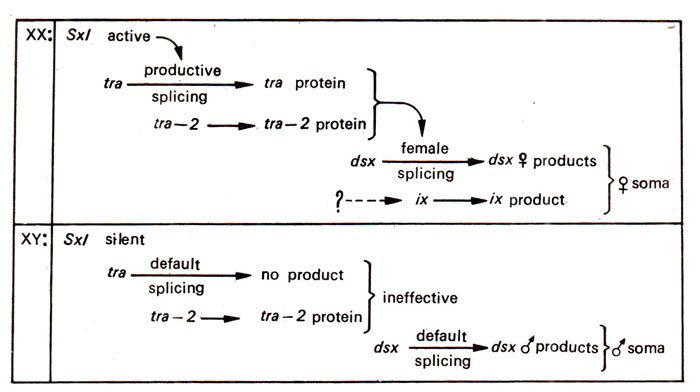
SEX DETERMINATION IN DROSOPHILA

Sex determination in Drosophila-
( By the ratio of x chromosomes to autosomes)
If X/A= 1 (female) XX:2A
If X/A =0.5 (male)XY:2A

1.XX genotyes-
In such embryos the Sxl Gene activated and produces a protein called Sxl protein.Which cause the splicing of tra pre mRna at a downstream 3' splice site and the termination codon is spliced out with the intron, which leads to production of tra protein. Tra protein interacts with Tra-2 proteins and together they direct the female specific splicing of dsx pre-mRNA ,which produces proteins that cause the embryo into a female .
( It is regulated in post transcriptional level).
2. XY genotyes-
In such embryos the sxl Gene is not activated and the sxl protein is not produced. So,tra premRNa spliced at an upstream site resulting in the inclusion of a premature stop codon in the mRNA producing a non functional Tra protein .
Without functional Tra the male specific splicing of dsx pre-mRNA takes place which produces male Dsx proteins that cause the embryo to develop into a male .
(Sxl- sex lethal 
Tra -Transformer
dSX-Double sex )

IMAGE SOURCE CREDIT-http://www.biocyclopedia.com/index/genetics/images/figure/f17.12.jpg


Thank you for visiting my  blog. Please share your comments on this


article.  Subscribe and follow me in Google + to get notified with new articles.

Friday, 28 July 2017

DNA DAMAGE AND REPAIR

Dna damage would be due to to mismatch base pairing , catalyzed by environmental agents(ionizing radiation ,certain chemicals and uv radiation ) and  may be spontaneously .

TYPES OF REPAIR                        PROTEINS/ENZYMES                                       EFFECTS

1.MISMATCH REPAIR                   Dam methylase, MUT -H                              Results in mismatch
                                                          MUT-L AND MUT-S proteins,                                   Bases
                                                          Dna helicase II, SSB,Dna pol III,
                                                          Exonuclease I,Exonuclease VII,
                                                          Recj nuclease ,Exonuclease X,
                                                          Dna ligase

2.BASE  
EXCISION REPAIR                         Dna glycosylase ,Ap endonuclease ,            A.  Abnormal bases
                                                             Dna polymerase -I ,Dna ligase                         (Uracil,xanthine,
                                                                                                                                        Hypoxanthine )
                                                                                                                                 B.Pyrimidine dimers

3.NUCLEOTIDE 
EXCISION REPAIR                          ABC exonuclease,DNA POL-I,                  Pyrimidine dimers
                                                            Dna ligase 


4.DIRECT REPAIR                          DNA photolyase                                          Pyrimidine dimers 
                                                      
                                                     correction of    O6 methyl guanosine 7 
                                                                    nucleotide                                          methyl transferase  
                                                               Repair of alkylated bases                               By AlkB(Alpha                                                                                                                                        keto glutarate                                                                                                                            Fe2+ dependent deoxygense )
5.Recombinant repair                             Repair of Double stranadard breaks. It utilise the homologos chromosomes by exonuclease.


Thank you for visiting my  blog. Please share your comments on this

article.  Subscribe and follow me in Google + to get notified with new articles.                                      

AMES TEST

(USED TO SCREEN CARCINOGENS AND MUTAGENS )
                                       Discovered by Bruce Ames

  • Histidine auxotroph (mutated ones)Salmonella typhimurium were taken which requires presence of histidine to grow.
  • It is mixed with rat liver enzymes and plated in a media which is devoid of histidine .
  • Liver enzymes are required to detect the mutagens that are converted to carcinoogenic form by the liver .
  • Test chemical (mutagenic) is then added to the medium .
  • Control plates lack the test chemical shows a small number of bacterial cells or colony growing without histidine .
  • Plated innoculated with mutagens (test chemical )show a larger number of revertants which implies the auxotroph converted to prototrophs by the presence of histidine which acts as a selectable marker .
(ALL CARCINOGENS ARE MUTAGENS BUT ALL MUTAGENS ARE NOT CARCINOGENS)

Thank you for visiting my  blog. Please share your comments on this

article.  Subscribe and follow me in Google + to get notified with new articles.

Wednesday, 26 July 2017

TYPES OF ECOLOGICAL EFFICIENCY

Ecological efficiency describes the efficiency with which energy is transferred as biomass from one trophic level to the next. It is determined by a summation of all the  efficiencies relating to organismic resource acquisition and assimilation in an ecosystem.

NOTE -Biodiversity is directly proportional to ecological efficiency .

1.Net production efficiency (NPE) measures how efficiently each trophic level uses and incorporates the energy from its food into biomass to fuel the next trophic level.

2.(A/I) The efficiency by which animals convert the food they ingest into energy for growth and reproduction is called assimilation efficiency. (Proportion of ingested biomass that consumers assimilate ).

JUNE 2017 CSIR NET ONE QUESTION WAS BASED ON THIS -

Herbivores assimilate  15 -80 percent of the plant material they ingest.

Carnivores have higher assimilation efficiency (about 80 percent) than do terrestrial herbivores (5 to 20 percent).

3.Consumption efficiency -Proportion of available biomass that is ingested by consumers .

4.(P/A) Production Efficiency-Production efficiency is the amount of energy that is allocated to animal production, including growth of the animal and animal reproduction. It is determined primarily by the metabolism of the animal.

5.Production to Consumption Index: ( Production/consumption; P/I) A measure of the efficiency with which energy is made available to the next group of consumersIndicates how much energy consumed by the animal is converted into production

Note-1.In case of insects =High production efficiency,Low assimilation efficiency
          2.HUMANS=Low production efficiency and high assimilation efficiency 
          3.Homeotherms: assimilation (A/I) is high: low production (P/A); very low (P/I) production to consumption ratio
            Poikilotherms: assimilaiton (A/I) :production (P/A); much higher (P/I) than that of homeotherms

(Homeotherms have a very poor production efficiency (P/A) giving a very low production to consumption ratio (P/I), and this is the opposite for poikilotherms )


Note- Endotherms have high DE( digestion efficiency) that is assimilation/consumption .

Ectotherms have low EE( ecological efficiency)
That is production/ consumption.

Thank you for visiting my  blog. Please share your comments on this

article.  Subscribe and follow me in Google + to get notified with new articles.

Sunday, 23 July 2017

KLENOW FRAGMENT (DNA POL I -LARGE FRAGMENT )

The Klenow fragment is a large protein fragment  produced when DNA polymerase I from E. coli is enzymatically cleaved by the protease subtilisin. 

The  cleavage results in  1. Small fragment of  322 amno acids having 5'-3' exonuclease activity .
                                   2.Large fragment of 604 amino acids having DNA polymerization and 3'-5' exonuclease activity .


The larger fragment retains the 5' → 3' polymerase activity and the 3’ → 5’ exonuclease activity for removal of precoding nucleotides and proofreading, but loses its 5' → 3' exonuclease activity.
The other smaller fragment formed when DNA polymerase I from E. coli is cleaved by subtilisin retains the 5' → 3' exonuclease activity but does not have the other two activities exhibited by the Klenow fragment (i.e. 5' → 3' polymerase activity, and 3' → 5' exonuclease activity).
The elimination of exonuclease activity makes Exo- Klenow Fragment the enzyme of choice for isotopic or biotin labeling of DNA probes by the random primed method and for DNA sequencing by the sanger dideoxy method.
Applications -


  • DNA blunting - By filling-in 5'-overhangs with unlabeled or labeled dNTPs
  • cDNA strand synthesis 
  • Generate single-stranded DNA probes using random primers
  • Site-directed DNA mutagenesis using synthetic oligonucleotides
  • Dideoxy DNA sequencing of single- or double-stranded DNA templates
  • 3’→5’ exonuclease activity can blunt a 3’-overhang.

    Thank you for visiting my  blog. Please share your comments on this

    article.  Subscribe and follow me in Google + to get notified with new articles.

    Friday, 14 July 2017

    BIOCHEMISTRY FLASH CARD

    1.GLYCOGEN AND STARCH ------- Alpha (1 -4)glucose (Branched and unbranched)

    2.CELLULOSE--------Beta(1-4)glycosidic bond of  glucose (unbranched )

    3.Insulin ---------------- 21 and 30 amino acids

    4. Chitin ---------------------- N-acetyl glucosamine with alpha (1--4 ) linkage

    5. Hemicellulose -------------D galactose

    6.ADP ribosylation----------- Arginine

    7. Uridylytion -----------------Tyrosine

    8. Mg2+ is an inorganic activator of ---------Phosphatase enzyme

    9. Zn2+ is an inorganic activator of ---------Carbonic anhydrase

    10.Penicillin -------------Block the active site of enzyme that many bacteria used to make cell walls.

    11. Phosphofructokinase allosterically regulated ---------------by ATP

    12. Phosphorylation and Glycosylation---------Ser residue involved

    13.Tyrosine --------------------------------Dopamine

    14.Methylation and Acetylation ------------------------------lysine

    15.Isocitrate lyase -------------------------------------------Synthesis of glucose from acetate

    16.PEP  Carboxylase --------------------------------------Conversion of aminoacid into glucose

    17.Pyruvate dehydrogenase complex-------------------Lipoic acid

    18.Phosphofructokinase -------------------------------An allosteric enzyme

    19.Pyruvate carboxylase ------------------------------Biotin

    20.Uronic acid-----------------------------------------Dermatan sulphate ,Chondroitin sulphate ,Heparin sulphate

    21.1,1-----Glucoside linkage -----------------------Trehalose

    22.Invert sugar --------------------------------------Hydrolytic product of sucrose

    23.Hyaluronic acid ---------------------------------Glucurnic acid and N- acetyl D- galactosamine

    24.Diasteromers------------------------------------Isoleucine and threonine (Also have 2 chiral centers)

    25.Non polar amino acids -----------------------In the core of proteins

    26.Arginine--------------------------------------Imidazole group

    27.Histidine-----------------------------------Guanidine group

    28.Name of test - a. Histidine and tyrosine ----------------------Pauly
                                 b.Tryptophan------------------------(glyoxylic acid reaction)Hopkins cole
                                 c.Arginine---------------------Milon
                                 d.Cysteine--------------------Nitroprusside
    29.Spingosine------------------------------------Ceramide ,Cerebrosides,Gangliosides,Spingomyelin

    30.Tay-Sachs disease -----------------------------Genetic defect in the metabolism of gangliosides

    31.Alpha keratin -----------------------------Mammals and Beta keratin-------Birds and Reptiles

    32.Major polysaccharide components of extracellular matrix----------------Glycosaminoglycans

    33.Lipids -------------Fatty acid ,spingolipid,glycerophospholipid ,triglecerides,chlesterol

    34.Transfatty acids--------------------By fermentation in the rumen of diary animals.

    35.The pentose sugar present mainly in the
    heart muscle is                                              -------------------------------------- Lyxose

    36.Dietary fats are transported as ----------------------------------------------------Chylomicrons

    37.Neurotransmitters ----------------------------------------Dopamine, serotonin,GABA,epinephrine 

    38.Energy related metabolites-----------------------------Creatine, citrulline ,carnitine 

    39.Carboxyglutamate-------------------------------Blood clotting proteins and Ca 2+ binding proteins 

    40.Methyllysine--------------------------constituent of  myosin

    41.Pyroglutamate---------------------Bacteriorhodopsin

    42.Ornithine and Citrulline--------------------Intermediates in biosynthesis of arginine and urea cycle

    43.Ketogenic amino acids ---------------------leucine and lysine

    Thank you for visiting my  blog. Please share your comments on this
    article.  Subscribe and follow me in Google + to get notified with new articles.